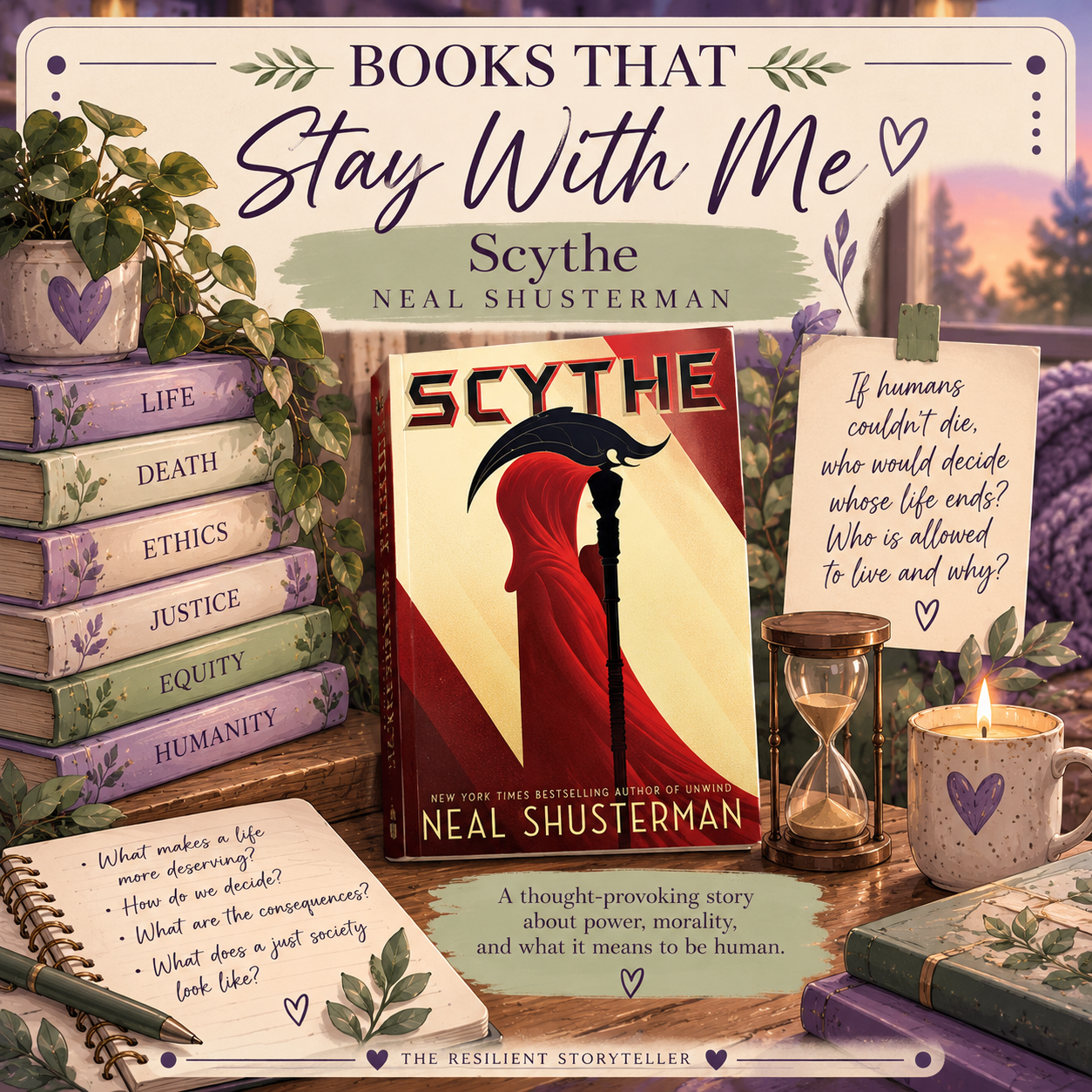
Title: Scythe
Author: Neal Shusterman
Who Gets to Decide Who Lives and Who Dies?
Some books stay with me because they teach me something.
Others stay with me because they make me question everything I thought I knew.
Scythe by Neal Shusterman is one of those books.
I love reading books that challenge the way I think, and this one certainly did.
Imagine a world where humanity has conquered death. Disease, aging, and even accidental death are no longer permanent concerns. People can live indefinitely.
But there's a problem.
If people no longer die naturally, how does society manage its population?
In this world, that responsibility falls to a group of individuals known as Scythes, who are given the authority to permanently end lives.
And that's where the questions begin.
As I read this book, I kept coming back to one question:
Who has the right to decide whether another person lives or dies?
If death were no longer a natural part of life, who would be responsible for determining when someone's life should end?
Would everyone have an equal chance at living?
Would wealth, power, status, or personal relationships influence those decisions?
Could anyone truly make those choices without bias?
And perhaps the most difficult question of all:
What makes one person's life more deserving of continuing than another's?
These are not easy questions, and I don't think they're supposed to be.
I often say that I am a social worker at heart.
Social work is rooted in values such as dignity, worth, social justice, and the importance of human relationships.
And this book challenged me to think about those values in an entirely different world.
As social workers, we advocate for people who may not always have the power, resources, or opportunities to advocate for themselves.
We recognize that systems are not always fair and that people do not always begin life with the same advantages.
So what happens when a system is given the ultimate authority over life itself?
Who protects the vulnerable?
Who holds those in power accountable?
And how do we ensure that every life is treated with dignity when someone must decide which lives will end?
What I appreciate most about Scythe is that it doesn't offer simple answers.
Instead, it creates a world that forces readers to confront complicated questions about morality, humanity, power, and justice.
It made me think about how much responsibility comes with making decisions that affect other people.
It also reminded me that just because society has the ability to do something doesn't necessarily mean we have figured out the ethics of doing it.
Sometimes we become so focused on what is possible that we forget to ask what is right.
And sometimes the most meaningful stories aren't the ones that give us answers.
They're the ones that leave us asking questions long after we've finished reading.
That's why Scythe has stayed with me.
Because every human life has value, and deciding the worth of another person's life should never be a simple question.
A Question for You
If humans could live forever, but someone had to decide when lives would end, who—if anyone—should have that authority?
Would you trust another person to make that decision?