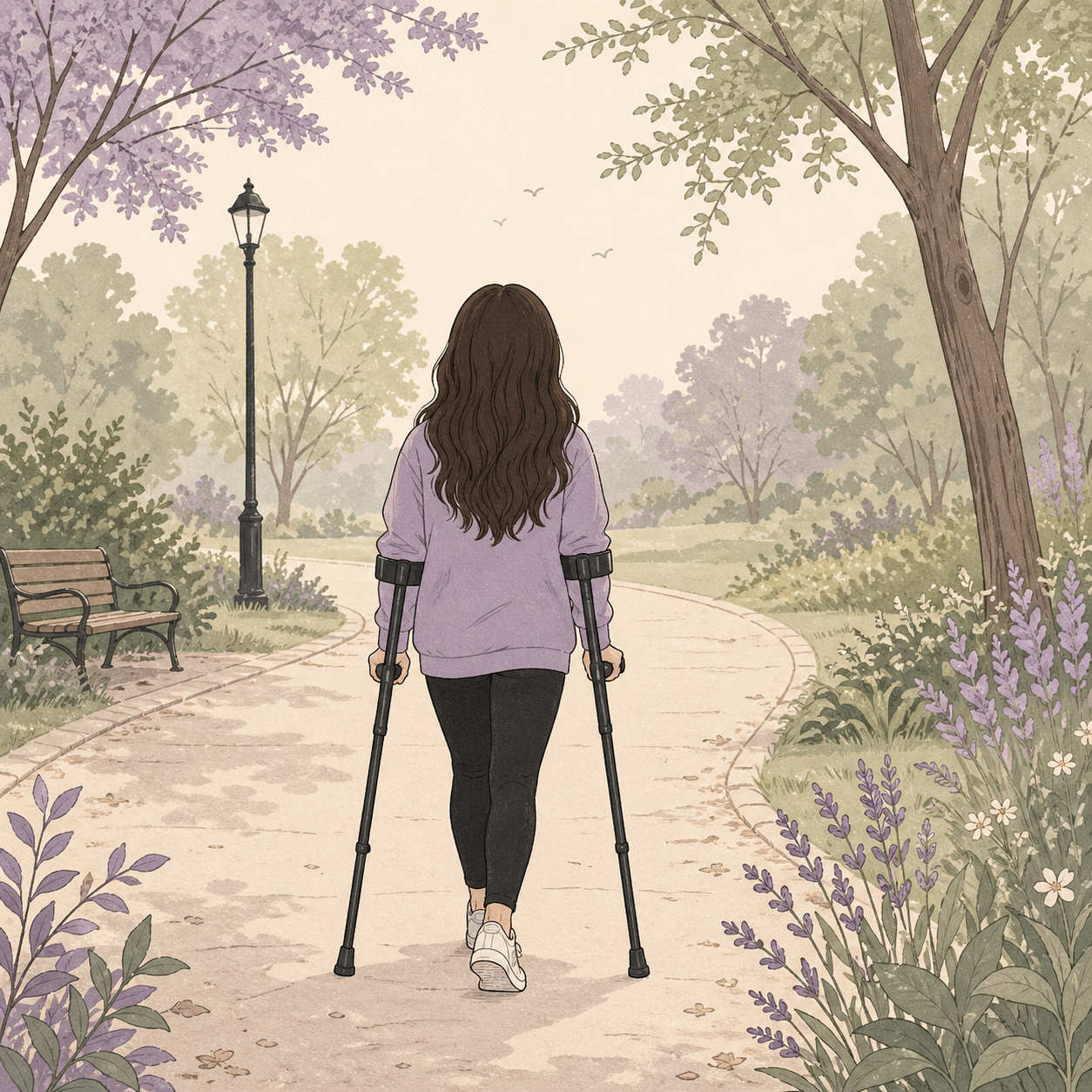
When we hear the word healing, there are often expectations of what it should look like—especially within the larger population.
Healing is supposed to be linear. Easy. Without setbacks.
But when it doesn’t look that way, we begin to feel like we are the ones to blame.
Physical Healing
Did I not do enough exercises?
Did I care for the surgical site properly?
Did I rest enough?
Maybe I pushed myself too much.
Mental & Emotional Healing
Did I not journal enough?
Am I doing my coping skills incorrectly?
Maybe I’m not meditating “hard enough.”
These are the ruminating thoughts that begin to bring us down. They slowly chip away at our self-esteem and push self-doubt to the forefront.
Even when we have a strong support system, others may unintentionally reinforce these beliefs. When our healing doesn’t follow a clear path, we may hear things like:
“What did you do?”
“Is that more swollen than it should be?”
They don’t mean to place blame—but it can still shift our thoughts in a more negative direction.
But I am here to tell you this:
Healing—of any kind—looks different for everyone.
Medical professionals and articles may suggest how long a surgery, wound, or procedure should take to heal. Insurance companies often expect it to happen even faster (which is a whole separate conversation).
In mental health, therapy is often structured in 6, 8, or 12 sessions for certain concerns—but those numbers are based on the least complex situations. They don’t account for real life, ongoing stress, or the depth of someone’s experiences.
Healing is not linear.
And it doesn’t exist in a closed room.
It is not perfect.
Healing is still happening—even when it feels messy.
It is completely normal for healing to look different for everyone.
It may be slow.
It may include setbacks.
But that does not mean it has stopped.
As a therapist, I see this every day. Some clients notice progress within weeks, while others may not feel shifts for months or even years.
There is no universal timeline for healing.
It happens on your time.
In my own journey, I have experienced both physical and emotional setbacks.
In sixth grade, I had surgery to shorten one leg in hopes of correcting my gait. Instead, it became one of the biggest setbacks of my life. I began using crutches and could no longer walk without them.
After that surgery, I lost a level of independence. Within a few years, the metal in my leg began to bend, changing the shape of my thigh. In high school, I underwent another surgery to try to correct this—adding new materials with the hope of returning to where I was before.
But it didn’t work. I still needed crutches to function daily.
It didn’t feel fair.
And for a long time, I felt like it was my fault—both times.
I did physical therapy.
I completed my home exercises.
I attended my follow-up appointments.
But none of it changed my gait or my need for crutches.
Through my own therapy, I’ve come to understand something important:
I have experienced difficult medical challenges—and they are not my fault.
Even though it is my body,
it is not my fault.
So I’ll leave you with this:
Healing is not one-size-fits-all.
And just because you don’t see growth,
doesn’t mean it isn’t happening.
Give yourself a little grace and compassion.